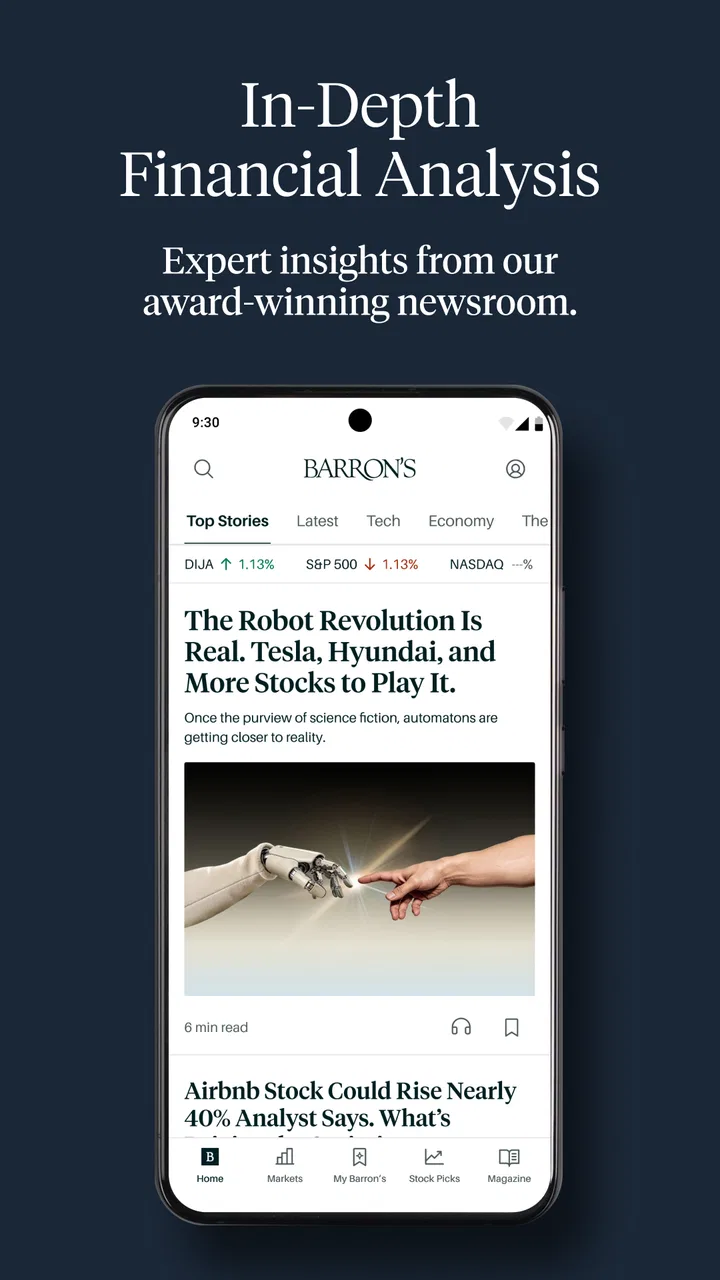
Barron's: Investing Insights
- 3.1
- Rating
- 100.00K
- Installs
- Free
- Price

 Analysis by App-foxy
I approached Barron's: Investing Insights as a reader who wants more than a quick market headline. The app belongs to the News & Magazines category and comes from Dow Jones & Company, Inc., with its focus placed firmly on stock-market developments, business, investing, and financial news. My first impression was that it is designed for people who want context around market movements rather than a simple stream of price changes.
That distinction matters. A standard finance app is usually built around watchlists, charts, alerts, or transaction tools. This one makes more sense as a reading companion. I would open it to understand why an industry is attracting attention, what business story sits behind a market move, or which themes deserve a closer look before I make my own decision elsewhere. It is not the kind of app I would use as my only investing tool, but it can occupy a useful place between breaking-news feeds and deeper research.
What feels useful during the first week
During the first few days, the appeal is straightforward: the app gives financial news a more deliberate setting than a general news reader. Instead of mixing market coverage with every other subject, it keeps the experience centered on companies, investments, and the global stock market. That focus can make a difference when I am trying to stay informed without being pulled into unrelated headlines.
You May Also Like

 Blood Strike: 2.5 Anniversary
Blood Strike’s Loadouts Turn Every Drop Into a Tactical Gamble
A close look at Blood Strike’s custom loadouts: how fast access to signature weapons reshapes its battle royale rhythm, rewards preparation, and narrows the gap between fights.

 Pandora - Music & Podcasts
Pandora’s Music Is Easy to Start, but Harder to Recover
Pandora’s strength is its low-effort path from a seed to a station. Its weak spot is how much confidence it asks you to place in connection, setup, and quiet recovery.

 8 Ball Pool
 Is Built on Rivalries, Rematches, and Routine
A close look at the rivalries, rematches, shared routines, and unanswered safety questions that turn a quick pool match into a persistent mobile community.

 Samsung Music
’s Quiet Strength Is Playing What You Already Own
Its reach comes less from spectacle than from dependable access to a personal library. That simplicity is both the app’s strongest retention engine and its ceiling.

 AccuWeather: Weather Radar
AccuWeather Review: A Quick, Clear Forecast for Everyday Decisions
For everyday plans, the best forecast is the one you can understand quickly. AccuWeather makes rain timing, radar, and local conditions easy to act on, with a few trade-offs.

 Hill Climb Racing
Why Hill Climb Racing Still Turns Crashes Into One More Run
A tiny car, a bumpy hill and one more upgrade: Hill Climb Racing keeps resurfacing because its simple chaos makes every near-miss feel personal.
More From Our News Desk



I found the best early use case was a short reading session at a predictable time. For example, I might check it before work to see which business stories deserve attention, then return later when a market move needs more explanation. This is more practical than opening a financial app repeatedly without a clear purpose. The value comes from building a reading habit, not from treating every article as an urgent signal.
The app is free to install, which makes trying it low-risk. It is rated for Everyone 10+, so its subject matter is aimed at a general audience rather than being presented as an adult-only service. At the same time, financial language can still be demanding for a newcomer. Terms connected with valuation, earnings, sectors, or market risk may require extra reading, so I would not assume that the age rating means the content is automatically beginner-friendly.
One useful habit is to separate reading from acting. I would first read a report for its explanation, note the companies or sectors mentioned, and only then compare that information with a dedicated market-data tool. This prevents the common mistake of treating a news article as a direct buy or sell instruction. The app works better when it helps form questions than when it is expected to supply instant answers.
The first-week experience also depends on how much financial news I already consume. Someone coming from general news may appreciate the stronger focus immediately. Someone already using several specialist publications may notice that the app overlaps with an existing routine. In that case, the question is not whether the articles are interesting, but whether this particular reading environment saves time or adds useful perspective.
Where it fits beside familiar finance apps
I would place this app beside, rather than above, the usual alternatives. A brokerage app is better for orders, account management, and portfolio actions. A market-data app is usually better for watching live prices, technical charts, and custom alerts. A general news app is more convenient for broad headlines, but it may offer less concentration on investing and business.
Barron's: Investing Insights makes the strongest case when I want editorial reading to sit next to those tools. I can use a charting service to identify a movement, then use this app to look for the business context behind it. That two-step workflow is more realistic than expecting one application to handle research, execution, portfolio tracking, and news equally well.
There is also a trade-off in choosing a focused publication app over an aggregator. An aggregator is efficient when I want many viewpoints in one place, while a dedicated publication can feel calmer and more coherent. The downside is that I may need another source to broaden the picture. For important financial decisions, I would never rely on one publication or one interpretation alone.
How the value changes after the novelty fades
The first week can be driven by curiosity, but lasting value has to come from repeatable usefulness. For me, that means the app needs to answer a recurring question: what can I learn here that I would not get from a quick headline or a price screen? Its strongest long-term role is helping me maintain awareness of business developments without turning every session into a frantic search for market noise.
A practical monthly routine would be to use it for three different purposes. At the start of a month, I might scan broad business themes. During the month, I could follow stories affecting companies or industries already on my radar. At the end, I could review which topics kept returning and decide whether they deserve deeper research. This makes the app part of an information process rather than a passive stream.
The important insight is that recurring value is more likely to come from continuity than volume. Reading every available item is neither necessary nor realistic. I would choose a small number of topics, keep notes outside the app, and return when a story develops. That approach reduces the pressure to check constantly and makes the reading more purposeful.
For a long-term investor, the app may be useful as a background source that keeps business conditions visible between portfolio reviews. For an active trader, it may be less satisfying if the main need is speed, precise price data, or immediate alerts. The same financial news can serve both people, but their timing requirements are different. This app appears more naturally suited to the reader who values interpretation over rapid execution.
It is also worth being realistic about the free label. The app itself is free, but it includes in-app purchases ranging from around two dollars to nearly two hundred dollars per item. That creates an important decision point for anyone planning to use it regularly. I would explore the free experience first and only consider spending if the reading value clearly supports the cost over time. A subscription-style commitment should be judged by repeated usefulness, not by the excitement of the first few sessions.
The maintenance work behind a useful habit
Keeping a finance-news app useful requires more maintenance than simply installing it. I would need to decide how often to check it, which subjects matter to me, and when to stop reading. Without those boundaries, financial coverage can become background anxiety rather than informed awareness. A short scheduled session is usually more sustainable than repeatedly refreshing throughout the day.
My preferred workflow would be simple. I would start with the main stories, open only the pieces connected to my interests, and write down a question or takeaway from each session. Later, I could verify prices and company details in a separate finance tool. This division of labor keeps the publication focused on reading while avoiding the expectation that it should replace a full investment dashboard.
Another useful discipline is to distinguish a company story from a portfolio decision. An article can explain a business development without proving that a stock is attractive at its current price. I would therefore treat the app as one research input. Before acting, I would check the company’s own filings or other reliable sources, consider my time horizon, and review the risks independently.
The app’s current version is 2.19.30, and it supports devices running Android 8.0 or later. That makes compatibility worth checking before building a routine around it, particularly if I use an older phone. On a supported device, I would still pay attention to how comfortably I can read for several minutes at a time. News apps live or die by the ease of returning to them, and even small friction can weaken a habit.
Because the developer is Dow Jones & Company, Inc., readers may approach the app with expectations shaped by the Barron’s publication brand. That can be a reason to try it, but it also raises the standard I would apply. I would expect the experience to feel worthwhile beyond a collection of generic market headlines. If my sessions repeatedly feel interchangeable with what I already see elsewhere, the app would struggle to earn permanent space on my phone.
What can cause reading fatigue
Financial news has a built-in fatigue problem: markets produce a constant supply of events, but not every event deserves attention. Even a focused app can encourage me to consume more information than I can use. If I open it whenever I feel uncertain about an investment, I may end up chasing each new explanation instead of following a consistent plan.
The subject itself can also feel repetitive. Companies report results, sectors rotate in and out of favor, and market concerns return under new headlines. A reader looking for entertainment or quick variety may lose interest sooner than someone who enjoys following business narratives over time. The app’s lasting appeal depends on whether I value context enough to tolerate that slower rhythm.
Another source of friction is the boundary between accessible news and specialist analysis. I appreciate financial writing that explains the significance of an event, but readers with limited investing experience may still need to look up unfamiliar concepts. Conversely, experienced investors may find introductory explanations unnecessary. That range means the app will not have one perfect level for everyone.
The purchase structure can create fatigue as well. Since individual in-app purchases can reach nearly two hundred dollars, I would not treat every locked or premium-looking element as an automatic upgrade. I would first ask whether it changes my decisions, improves my understanding, or simply gives me more material to read. More content is not always more value, especially when my existing routine is already crowded.
Its average rating is around 3.1 from roughly a thousand ratings, with a few hundred written reviews. I would read that as a signal to keep expectations measured rather than as a final verdict. Ratings can reflect different expectations, device experiences, and opinions about access or value. For me, the practical test is whether the app remains useful after the initial curiosity and whether its reading experience fits my existing tools.
Who should make room for it
I think the app is worth trying if I regularly follow companies, industries, or investment themes and want a dedicated place for financial journalism. It may suit a long-term investor who wants more business context, a student building a market-reading habit, or a professional who prefers a focused news session before reviewing data elsewhere.
It is less suitable for someone who mainly wants to trade from a phone. I would choose a brokerage or market-data application first if my priorities were order placement, detailed charting, portfolio balances, or fast alerts. I would also hesitate to make it my only source if I need a broad range of political, local, technology, and general-world coverage in the same feed.
For a beginner, I would recommend using it slowly. Pick one company or sector, read related coverage over time, and keep a small glossary of unfamiliar terms. Do not measure success by how many articles you finish. Measure it by whether you can explain the business issue more clearly after reading and whether you can identify what still needs verification.
For an experienced reader, the better question is whether its perspective adds something distinct to an existing information stack. If I already pay for several financial publications and rarely finish them, installing another one may add clutter. If I want a more intentional reading routine and this app gives me a reason to return, it can earn its place.
My long-term verdict
The lasting value here comes from disciplined financial reading, not constant checking. I would recommend Barron's: Investing Insights as a companion for market understanding, especially when I want business context rather than a bare price movement. Its free entry point makes experimentation easy, while the available in-app purchases mean I would evaluate ongoing cost carefully before committing.
I would keep it installed if it helped me follow a small set of themes, prepare better questions, and understand why a market story mattered. I would remove it if it became another source of repetitive headlines, purchase pressure, or unnecessary market anxiety. That is the central trade-off: the app can support a thoughtful routine, but it cannot create one automatically.
My final recommendation is therefore conditional but positive. Try it alongside a separate market-data or brokerage tool, use it at set times, and judge it after the novelty has passed. If the articles consistently improve your understanding of companies and investments, it can justify a regular place in your news routine. If you only need quotes, charts, or transactions, a different finance app will serve you better.
FAQs for Barron's: Investing Insights
01What features does Barron's: Investing Insights offer?
Barron's: Investing Insights provides a comprehensive suite of tools for investors. It includes real-time market data, in-depth analysis, and expert commentary. Users can access personalized watchlists, breaking news alerts, and detailed reports on stocks and investment trends. The app also offers exclusive articles and financial insights from leading industry experts.
02Is Barron's: Investing Insights suitable for beginners?
Yes, Barron's: Investing Insights caters to both novice and experienced investors. While it provides advanced tools and analytics for seasoned investors, beginners will find the educational resources and expert articles helpful to understand market trends and investment strategies. The app's user-friendly interface makes navigation easy for all skill levels.
03Does Barron's: Investing Insights require a subscription?
Barron's: Investing Insights operates on a subscription model. While some features might be accessible for free, a subscription is needed for full access to premium content, including exclusive articles, detailed market analysis, and personalized investment advice. Several subscription plans are available, tailored to different user needs.
04Can I use Barron's: Investing Insights offline?
Barron's: Investing Insights requires an internet connection for most of its features, such as real-time updates and news alerts. However, users can save specific articles or reports for offline reading. This feature allows you to review content without an active internet connection, making it convenient for on-the-go access.
05How does Barron's: Investing Insights protect user data?
Barron's: Investing Insights takes user privacy seriously and employs robust security measures to protect data. The app uses encryption to secure personal information and financial data. Additionally, it adheres to strict privacy policies and is compliant with data protection regulations to ensure user information is handled responsibly.
Pros
- Comprehensive market analysis tools.
- User-friendly interface for all levels.
- Real-time data updates and alerts.
- Customizable watchlists and portfolios.
- Access to expert financial insights.
Cons
- Requires subscription for full features.
- Occasional app crashes reported.
- Limited offline access to data.
- Some features may overwhelm beginners.
- Notifications can be excessive.

Barron's: Investing Insights
Gallery